Queer Places:
University of London, Senate House, Malet St, London WC1E 7HU, United Kingdom
University of Cambridge, 4 Mill Ln, Cambridge CB2 1RZ
St Martin Churchyard, 1 N Holmes Rd, Canterbury CT1 1QJ, United Kingdom
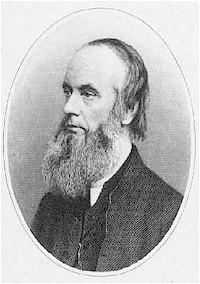 Henry Alford (October 7, 1810 – January 12, 1871) was born in London on October 7, 1810, into a Somersetshire family with a rich lineage that had provided five consecutive
generations of clergymen to the Anglican Church. His early years were spent primarily with his widowed father, who served as a curate in Steeple Ashton, Wiltshire.
Displaying remarkable intellectual precocity from an early age, Alford had already written several Latin odes, a history of the Jews, and numerous homiletic outlines before
he reached the age of ten. Following a peripatetic early school course, which included time at Ilminster Grammar School under Mr. Allen, he entered Trinity College,
Cambridge, as a pensioner in December 1827 and became a scholar in 1830. A brilliant academic, he served as President of the Cambridge Union in 1832 and graduated that same
year as the 34th Wrangler and 8th Classic. He was also a noted member of the elite Cambridge Apostles. He was elected a
fellow of Trinity in 1834, securing his Master of Arts in 1835, Bachelor of Divinity in 1850, and Doctor of Divinity in 1859.
Henry Alford (October 7, 1810 – January 12, 1871) was born in London on October 7, 1810, into a Somersetshire family with a rich lineage that had provided five consecutive
generations of clergymen to the Anglican Church. His early years were spent primarily with his widowed father, who served as a curate in Steeple Ashton, Wiltshire.
Displaying remarkable intellectual precocity from an early age, Alford had already written several Latin odes, a history of the Jews, and numerous homiletic outlines before
he reached the age of ten. Following a peripatetic early school course, which included time at Ilminster Grammar School under Mr. Allen, he entered Trinity College,
Cambridge, as a pensioner in December 1827 and became a scholar in 1830. A brilliant academic, he served as President of the Cambridge Union in 1832 and graduated that same
year as the 34th Wrangler and 8th Classic. He was also a noted member of the elite Cambridge Apostles. He was elected a
fellow of Trinity in 1834, securing his Master of Arts in 1835, Bachelor of Divinity in 1850, and Doctor of Divinity in 1859.
Alford took holy orders early in his academic journey, being ordained a deacon in Exeter in 1833 and a priest in London in 1834. He initially served as a curate to his
father in Ampton, Suffolk, before beginning an eighteen-year tenure in 1835 as the vicar of Wymeswold in Leicestershire. During this peaceful rural period, he steadfastly
declined multiple offers of a colonial bishopric. He further established his intellectual reputation by serving as the Hulsean Lecturer at Cambridge from 1841 to 1843, and
concurrently working as an examiner in logic and moral philosophy at the University of London from 1841 to 1857. In 1844, he joined the Cambridge Camden Society and famously
commissioned architect A.W.N. Pugin to restore St Mary's Church in Wymeswold. Seeking closer engagement with continental scholarship, Alford travelled to Bonn, Germany, in
1847 to master the German language, recognizing the immense value of contemporary German biblical criticism. In September 1853, he left Wymeswold to become the minister of
Quebec Street Chapel in Marylebone, London, attracting a large and cultured congregation. His career culminated in March 1857 when Prime Minister Lord Palmerston advanced
him to the deanery of Canterbury, a position he held with great vigor until his death. During his later years, he also joined the Metaphysical Society, founded in 1869 by
James Knowles.
On March 10, 1835, Alford married his cousin Frances "Fanny" Oke Alford, daughter of the Reverend Samuel Alford of Heale House, in Curry Rivel, Somerset. The couple had
four children during their time in Wymeswold, though tragedy marked their family life as both sons died young. Their first son, Clement Henry Oke, died in 1844 at eleven
months old, and their second son, Ambrose Oke, passed away in Torquay at the age of ten in 1850. They also had two daughters, Alice Oke, who married the Kensington Palace
chaplain William Thomas Bullock, and Frances Mary Oke, who married the Reverend Henry Edmund Tilsley Cruso in 1867.
Regarding potential historical LGBTQ+ links, while Alford was a prominent member of the Cambridge Apostles—a secretive intellectual society known to occasionally foster
intense homosocial and sometimes homoerotic bonds among Victorian elite men—there is no historical or biographical evidence indicating that Alford himself engaged in or
maintained any same-sex romantic or sexual relationships. His life trajectory, public record, and personal writings strictly reflect a conventional Victorian clerical
marriage and family life.
Alford was a man of extraordinary versatility and varied accomplishments, known as a scholar, theologian, textual critic, poet, hymnodist, water-colour painter, and
musician who possessed considerable mechanical skill. He authored several volumes of verse, including The School of the Heart and The Abbot of Muchelnaye, and translated
Homer's Odyssey into blank verse. He also wrote the popular language guide A Plea for the Queen's English and left a lasting legacy in Christian worship through his hymns,
most notably "Come, ye thankful people, come," "Forward! be our watchword," and "Ten thousand times ten thousand." As a churchman and editor, he directed Dearden's Magazine
and served as the founding editor of the Contemporary Review from 1866 to 1870. His crowning intellectual achievement was his monumental eight-volume edition of The Greek
Testament, produced between 1841 and 1861, which revolutionized English biblical studies by integrating rigorous philological analysis and advanced continental scholarship.
He also edited a seven-volume collection of the works of Dr. John Donne and participated in the revision of the New Testament. Henry Alford died on January 12, 1871, at the
age of sixty, and was buried beneath a yew tree on the west side of St. Martin's Churchyard in Canterbury. Choosing his own epitaph, his tomb is inscribed with the phrase
Diversorium Viatoris Hierosolymam Proficiscentis, meaning "the lodging place of a traveller on his way to Jerusalem." His widow, Frances, published his official biography in
1873 and passed away in Middlesex in November 1878.
References:
Other references:
- Official Biography: The Life, Journals, and Letters of Henry Alford, D.D., Late Dean of Canterbury, edited by his widow (Fanny Alford) (London: Rivingtons, 1873).
- Family and Genealogical Records: Alford Family Notes, Ancient and Modern, containing records compiled by family members and manuscript notes tracing the Somerset and London branches.
- Biographical Dictionaries: Dictionary of National Biography (D.N.B.) entry for Henry Alford.
- University and Academic Records: Alumni Cantabrigienses, compiled by John Venn and J. A. Venn, recording his admission, scholarship, fellowship, and academic honors at Trinity College, Cambridge.
- The Greek Testament: with a critically revised text, a digest of various readings, marginal references to verbal and idiomatic usage, prolegomena, and a critical and exegetical commentary (4 vols., 1849–1861)
- The New Testament for English Readers (4 vols., 1868)
- The School of the Heart, and Other Poems (1835)
- The Abbot of Muchelnaye, and Other Poems (1841)
- A Plea for the Queen's English (1863)
- The Riviera (1870)
Support this project
This website is a passion project researched, developed, and funded entirely by me. If you find the content valuable and would like to help support the ongoing research and hosting costs, any contribution is deeply appreciated.
Thank you for keeping this independent resource alive!
My books on Amazon: Elisa Rolle's books
BACK TO HOME PAGE
